



* Lew’s books
Posted by Lew Weinstein on September 2, 2014
Posted in Uncategorized | Leave a Comment »
* Portofino … view from the terrace … after 20 years
Posted by Lew Weinstein on September 2, 2014
Visitors to our home in Key West, or our former home in Manhattan, will recognize this painting by Kerry Hallam, which we purchased in NY about 20 years ago. Many of you have asked where it was painted and if we had ever been there. Well, it was painted in Portofino, and yesterday, we were there.

Our intent was to identify the exact buildings that Hallam painted and the precise spot where he painted from. And we succeeded!
The buildings were easy, the patio not so. We lined up the sight lines but could see nothing like the terrace on the hill opposite those buildings. Then we found some shops on a hill and continued up. There it was. For us, it was a really exciting moment.
Here is the view, from ground level and from Hallam’s terrace.

And here we are on the terrace.

We walked back into town and looked up. No terrace visible. We had to walk all the way out to the last buildings in the port to catch just a tiny glimpse of the terrace nestled into the hillside foliage.

We felt triumphant and decided to treat ourselves, first to a glass of prosecco, than to a delightful meal at the best-located port-side taverna.

***
Posted in ... 2014, ... Italy - Portofino | Leave a Comment »
* our Oxford Experience … 2014
Posted by Lew Weinstein on August 8, 2014

This is our third time at Oxford, the other two being in 2010 and 2012. The Oxford Experience summer program runs for six weeks, from Sunday to Saturday. About 12-14 courses are offered each week, in a variety of areas: British history & literature, music, philosophy, science, and of course Alice in Wonderland, since Alice lived in Oxford.
Paris to Oxford … taxi to Gare Nord, Eurostar to London, taxi to Paddington Station, train to Oxford, taxi to hotel. We arrived on Saturday and stayed in a small hotel in Oxford. First stop: The Bear, the oldest pub in Oxford, for a cold one and a bag of crisps.

We went to Blackwells in Oxford, maybe the best book store in the world. While I was in the history section looking for more books relevant to my research, Pat took a break and read a book of poems by Billy Collins, her favorite poet. Here she is with Billy at the KW Literary Seminar in January.

Just when we decided to go to dinner on – the only night not included in our Oxford Experience package – the heavens opened and it began to pour. Streets were flooded and it came down in buckets. Not to worry. Our hotel is located just above a restaurant, and not any restaurant, but Jamie Oliver’s (aka The Naked Chef) Italian. We each had an excellent meal and by the time we were done, it looked like it had never rained.

Check-in begins at noon on Sunday, and we saw some familiar faces from our prior visits. Students are assigned to help with the luggage and we were soon ensconced in our lovely en-suite dormitory room. Pat ran off two entries down to iron the clothes that had been living in our suitcases for five weeks. One does dress differently at Oxford. The jeans have been retired for the time being.

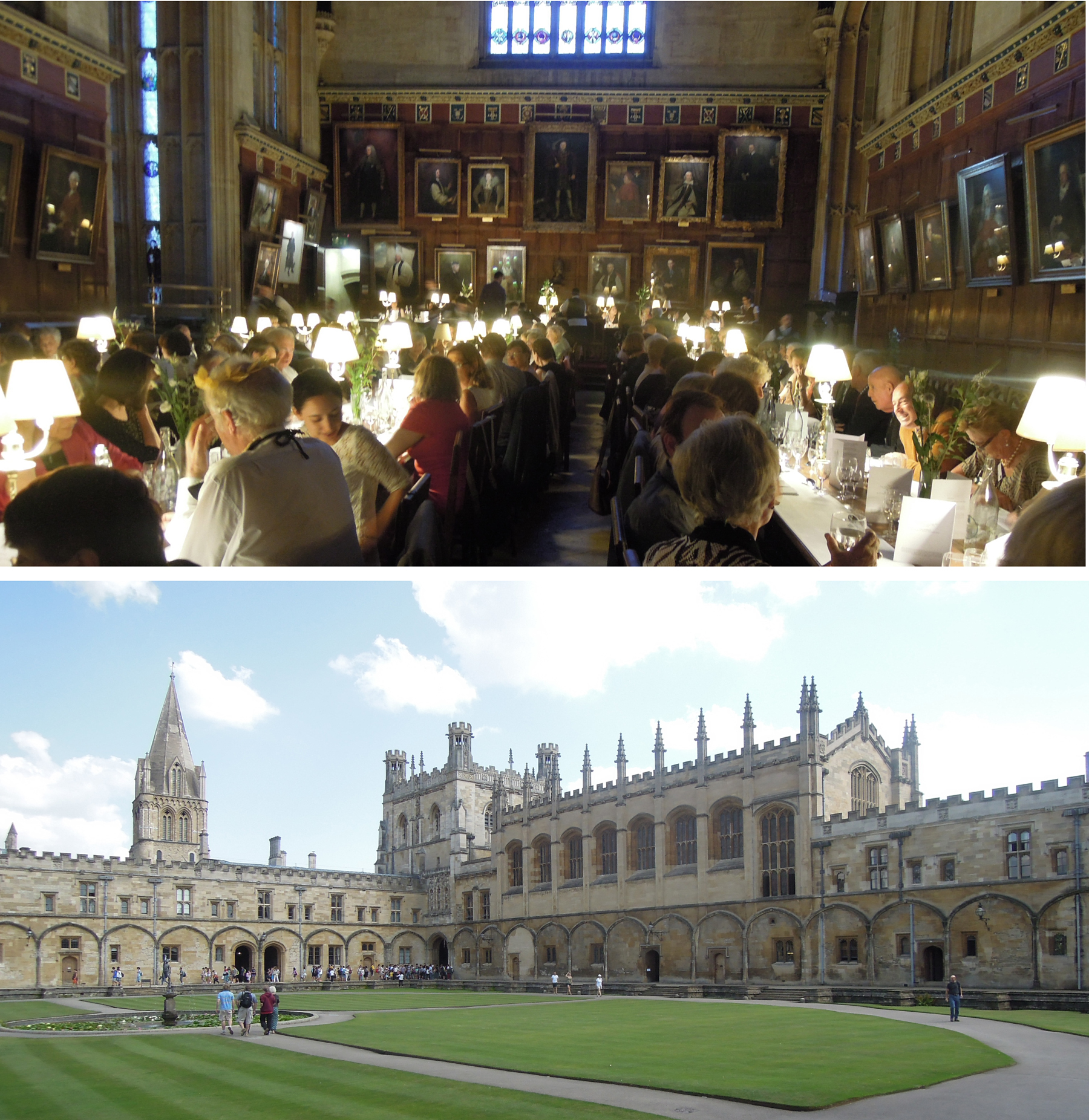
One of the great thrills of being at Christ Church in Oxford is that we eat all of our meals in the dining hall built by King Henry VIII and Cardinal Wolsey. Queen Elizabeth ate here – both Queen Elizabeths. And so did Harry Potter.

Our course this year – we both took the same course for the first time – was titled Toulouse Lautrec and the Artists at the turn of the Century in Paris. There were 12 in our class, and everyone contributed. Out tutor was Gillie McNeill. Gillie taught the course on the brain I took in 2012; she is a neuroscientist. Her avocation and lifelong passion is art, and she has lobbied for years to get Oxford to schedule her course. We were the beneficiaries of her persistence. Class goes from 9:15 to 12:30, with a tea break in the middle.

We studied many outstanding paintings, by Lautrec and others (Manet), spending intense minutes with many of them, seeing in a new way. Gillie is so much fun to be with, and she led what all of us thought was a great learning experience. Here is Paris in 1900, the Opera and the Moulin Rouge.

This one by Manet evoked long discussion, in class and on the web – I posted it and invited comments.

Here are some of the almost 50 comments from my great Facebook friends …
- There’s a sadness in the girls eyes. She’s probably the minimum wage fast food worker of the 1890s… serving drinks to the 1% in a dress that cost her a month’s wages out of her own pocket just to get the job. I say this because she looks detached and distant from the revelry around her.
- With her detached expressionless face, she daydreams of a life of wealth and aristocracy instead of being a servant to them . Sort of like our own middle class today .
- she is damn tired of serving those ignorant aristocrats
- a woman standing alone on her own two feet was not feeling independent but rather sad and vulnerable!!!?
- If catering to this decadence means I have to wear this corset ONE MORE MINUTE… Lord, another hour before my shift ends.
- there seems to be a man in the mirror that is speaking to her, but she clearly is not looking at him
- She wants the party to end, as none of the champagne, roses, fruit, and chandeliers are for her.
- what sort of interaction there is going on between “the man in the mirror” and the woman?
- She is young, beautiful and vulnerable- BUT her back is turned to the crowd, to le monde. Her gaze is introspective. She’s not looking at the man in the mirror who is looking at her. Yet I think she IS seeking that special person, who will see her individuality rather than her functionality as a mere dispenser of food and drink. Does the separate rose in the glass before her have symbolic significance? I’ve never seen this fascinating painting but would bet my life that nothing in it is accidental!
- She’s thinking I’ve had enough. I’d like to go home. He’s thinking I sure would like to go home with her.
- She was alone in a room full of people, invisible in a way..she wants you, the viewer to take her away, to some new and more interesting place,life.
- she will always be the secret, never in the crowd with him, always in the shadows without him. Always behind the bar, never in the crowd, properly acceptable, enjoying life like those surrounding her.

One of the traditions of the Oxford Experience is a night at High Table at the front of the dining hall where students share the meal with faculty. Each student is invited to one High Table during their stay. We met early for sherry and were treated to unlimited wine during the meal. I’m wearing a bow tie in Princeton colors which Pat bought for me just for this night. After dinner, we went to the Master’s Garden for croquet and champagne. Of course.

Jane Avril was one of Lautrec’s friends and also a frequent model. She was a dancer at the Moulin Rouge known for her strange ability to twirl her leg.

Lautrec never ridiculed or look down on his subjects, who were often prostitutes. He always treated them with respect. Notice he put himself in the Moulin Rouge scene.

Our Key West friends Norma and Dick have a long-time friend Joan who lives in Oxford. We had a delightful lunch today with Joan and her daughter Helen.

.
On the last day of class, each of us was asked to choose a painting and talk about it for 2 minutes. Pat and I chose Lautrec’s portrait of his friend Van Gogh, and rather than critique the painting, we wrote and performed a skit about the night Lautrec showed the portrait to Van Gogh.

an original skit by Pat and Lew
An apartment in Montmartre. It is 3:00 am. There are bottles and plates and glasses strewn about. Henri and Jane are talking after the others have left the party.
Henri: Jane, are you sober enough for serious conversation.
Jane: How dare you, Henri. You had 3 drinks for every one of mine. What conversation do you want to have?
H: I’d like your opinion as to how this evening went? Do you think Vincent like my portrait of him?
J: Why do you care what Vincent thinks? He’s half crazy and he’s never sold a painting, and probably never will.
H: Oh Jane, that’s not nice. He’s my friend. And besides, I think someday his work may be noticed.
Jane looks at the painting, which is on an easel off to the side of the room.
J: Well, I liked it. I especially liked the way you put in the bright colors. You haven’t done much of that lately.
H: Who do you think encouraged me to do that? And also those bold brush strokes.
J: Why did Vincent tell you to use color? He paints all those dark scenes from Holland. Who wants to look at his dark paintings? He has one of people eating potatoes. Who cares?
H: He may agree with you. In his latest work, he’s starting to use more color. We’re learning from each other and helping each other experiment.
J: Theo (Van Gogh’s brother) seemed to like your painting.
H: Yes, he even mentioned he might want to buy it.
J: If he does, will he put it up for sale? Or maybe give it to Vincent as a gift?
H: So let’s get back to my question. Did Vincent like his portrait?
J: He probably did. If not, he might have doused it with wine and set it on fire. You just never know what he’s going to do.
H: Please, Jane. He would never do anything like that … What did the others think?
J: Your cousin Gabi certainly liked it. And I think Emile did also.
H: As much as I love Gabi, his opinion is biased. Emile may be more objective.
J: Emile said he thought you made Vincent look older than he is. He was surprised by the colors. First he thought they were a little childish, but the more he looked at it, the more he liked it.
H: You mean the more he drank the more he liked it.
J: Well, that too. By the way, Vincent was quite surprised when you unveiled it. How did you paint it without him knowing about it?
H: We met for drinks one day last week. I stayed in the shadows when Vincent arrived and made a quick sketch. Then I did the rest in the studio that night.
J: Quite devious of you, Henri. Do you have sketches of me that will someday appear on your canvas?
H: Ah, Jane. I love you but you have to allow me my secrets. You’ll just have to wait and see. Maybe some day I will make Jane Avril as famous as this portrait will make Vincent Van Gogh.
J: And also as famous as Henri Toulouse Lautrec.

On the last night, the dinner in the great hall is a little more formal. The men wear coats and ties, the ladies dressed in their finest and looked fantastic. One of our new friends gave a sparkling party before the final reception …

Here is most of our class at the champagne reception before the final dinner …

Our final dinner in the great hall, and a last look at the Christ Church quad …
***
Posted in ... 2014, ... UK - Oxford | Leave a Comment »
* 3 times in Paris in a month
Posted by Lew Weinstein on August 8, 2014
Our European travel plans started in Paris, then to Amsterdam, back to Paris, Eurostar to London & Oxford, then back to Paris. Three times in Paris for a total of 11 nights.
The first time we treated Paris as if it was our home city, which in many ways it is. We stayed at the Perle Hotel in the 6th, where we have been many times before. After morning coffee and croissant at one of our favorite cafes, I got a new carryon bag at Galeries Lafayette after not being able to get a wheel changed on the one I brought. Pat found an optician to change out her lenses into a new frame. We met up with our friends Rawy and Nijole, had a nice dinner around the corner from our hotel, ice cream across the street.

At the church of Saint-Sulpice, down the street from the Perla, are three magnificent generally unknown paintings by Eugene Delacroix. This one is a portion of Heliodorus Driven from the Temple.

We left most of our luggage at the Perle and took the train to Amsterdam for our houseboat adventure. On our return, again staying at the Perle, we went to a magnificent exhibit at the Petit Palais – Paris 1900: The City of Entertainment. This is but a small sample of what is a remarkable collection.


From the Petit Palais it’s a short walk to the Champs-Élysées, where we enjoyed a small repast at an outside but shaded table at La Duree

Abercrombie and Fitch opened its flagship store on the Champs in 2011. From the front gate to the excitingly dark interior to the half-naked studs available for photos, this is way more than just a store.

Last year in Paris we accidentally met Philippe Benhamou and were invited to attend his two-man comedy show, which was great entertainment even though we didn’t understand a word. (He told us his part was in English, but neglected to mention he didn’t say any words.) This year we met on purpose and learned he is preparing a one-man show which will open in January.

Whatever else we do in Paris, the best thing to do is to walk around and just soak it all in. The building below is the Musee D’Orsay, which was magnificent as always but does not permit photos.

We often forget to take photos of our apartments. This is one of Adrianne Leeds, on rue de Roi du Sicile.

Time to go. No more Paris until next year. Of course, you never know.

***
Posted in ... 2014, ... France - Paris | Leave a Comment »
* even supposedly seasoned travelers can still do very stupid things
Posted by Lew Weinstein on August 3, 2014
Because of our adventures with the baggage handlers at Orly we were over an hour late arriving in Nice. Richard, who had arranged to meet us around 2:00 pm, had gone off to handle other business on what for him is a very day (He manages several apartments in different locations and Saturday is a transition and cleaning day). But he soon returned and let us into our apartment (see prior posts). Then he left.
We immediately recognized that we had failed to ask several questions and ran out into the hall to catch him. The door blew shut behind us. Both keys were inside the apartment.
Pat raced down the stairs but Richard was already gone. All of our luggage (including our phones), was inside the apartment. We were now in the lobby, realizing just how stuck we were. We couldn’t leave the building since we would be unable to get back in without the keys and fob. We couldn’t contact Richard since we didn’t have phones or his mobile number – we had always before contacted him by email. There was no place but the hard marble floor on which to sit, and no readily available bathroom. Richard would probably return eventually, but it might be many hours and there was always the chance he had gone for the night. There is a building concierge but he was not on duty.
A couple entered the building. The woman spoke no English but the man did. We showed him the mobile number of the concierge, which was posted, and he agreed to make the call. Pat went with them to their apartment and I stayed in the lobby in case Richard returned. The concierge did not answer his phone. The man said his neighbor had Richard’s mobile number, went to get it, and called. Richard did not answer. Pat left a message.
An hour had passed. We considered other options. It might be possible to climb from the adjoining apartment balcony to ours. Two problems. How to get in the other apartment. And how to survive the fall from the 5th floor if the climb failed. Think of something else. Call the police? We’d probably get arrested ourselves. The fire company? We decided to wait, calling Richard every 30 minutes or so. Another hour passed.
Richard answered his phone and said he would return in five minutes. That was the good news. The bad news was he did not have another key. The concierge had one, but he was not reachable.
Richard arrived, expressed no anger with our stupidity which had clearly interrupted his busy day, and said, “I don’t have a key, but I will arrange a solution.” For the first time in hours, thoughts of sleeping on the marble floor, or the beach, or even being arrested as vagrants, left our minds. Richard set about calling the cleaning personnel who did have keys. He found one, who was just about to leave Nice, but who gave the key to her daughter who said she would bring it to the apartment.
Another hour passed. Richard entertained us in his apartment and I went to the supermarket (optimistically) to get wine and cheese for the evening. The young lady arrived while I was gone. Pat went up with her and retrieved our keys. By the time she got back down, I was back and Richard was already gone, back to his tasks.
We like to think we are really good travelers and I think, on balance, we are. But when we make a stupid mistake, it can really be a doozy. Thanks so much to Richard, the young lady, and the couple who helped us. We unpacked, then sat on our terrace as it got dark, eating cheese and potato chips, and finished the entire bottle of wine.

Posted in ... 2014, ... France - Nice | Leave a Comment »
* Paris to Nice was an adventure … kudos to Air France for dealing with a baggage handlers’ strike
Posted by Lew Weinstein on August 3, 2014

Earlier in the week, we had dinner with our Paris friends Marilyn and Bernard. When we told them we were planning to fly to Nice on Saturday they told us it was the absolute worst travel day of the year, which the French call Black Saturday, the first Saturday of the August vacation season. We were advised to leave plenty of extra time, or even go to Orly on Friday night and stay in a nearby hotel.
We opted to arrange a taxi at 8:00 am for a 12:20 flight. and were pleasantly surprised when the drive to Orly took only 15 minutes, half the usual time in normal traffic. We quickly used the kiosk to get both our boarding passes and our luggage tags. So far so good, but it still turned out to have been a really good idea to have left early.
By 8:30 we were in line to drop the already tagged luggage. The airport was crowded and it was a long line, but one which should have taken no more than 20-30 minutes. It took over 2 hours. A baggage-handlers strike had put the Orly terminal into chaos. There are automated machines for taking the pre-tagged luggage, but most passengers could not figure out how to make them work, and the baggage handlers stood by and did not help. It was taking 5-15 minutes to process each piece of luggage.

Air France management personnel did a terrific job answering questions and supplementing the baggage handlers, who stood there but did nothing. I tried to find out what the strike was about, and was told it had to do with “working conditions.” When I asked for more details, the condition they were complaining about seemed to be that they were being asked to work.
We finally got through the line and had time for coffee and croissants. Then the flight was delayed, probably due to the baggage handlers not moving the luggage quickly onto the plane. We took off over an hour late, but amazingly, our luggage arrived with us in Nice.
Posted in ... 2014, ... France - Paris, problems, Uncategorized | Leave a Comment »
* five nights on a houseboat in Amsterdam
Posted by Lew Weinstein on July 28, 2014
AMSTERDAM
We were two days in Paris before taking the train to Amsterdam, and two more days after returning to Paris. I’ll include those days later, making one Paris post for 2014.
Our houseboat was located on the Prinsengracht canal next to the Noordermarkt in the Jordann district of Amsterdam, a perfect spot to enjoy the casual sophistication of a great city. Inside it was larger and more comfortable than I had expected. But the main joy was the porch along the water side, perfect for reading and watching the boats go by.

On our first morning in Amsterdam, we walked to the fabulous Rijksmuseum. This is a small sampling of the great masterworks to be found there …

Amsterdam is a great walking city, with exquisite views in every direction (well, most directions), and many fine restaurants. We had tapas during the World Cup final, cottage pie in an Irish pub, and a really splendid meal in an Italian restaurant. Here are a few shots just walking around, including our houseboat from the other side of the canal and the window-washer-in-a-boat.

***
Posted in ... 2014, ... Amsterdam | Leave a Comment »
* two weeks in Martha’s Vineyard … sublime
Posted by Lew Weinstein on July 22, 2014
MARTHA’S VINEYARD
From New York, we flew from LaGuardia direct to the Vineyard. Our first night was in a B&B in Edgartown which Pat found on AirBnB. The next morning our very helpful host (who had picked us up at the airport) also drove us to the lovely little cottage (half of a duplex) on Herringcreek Road just past the Katama fork.
We settled in and the next morning rode our bikes to the beach (2.5 mi each way). Check that one off. Now we don’t have to go again.

Menemsha is a special place. Our wonderful landlady Rita drove us over and we each had a terrific dinner – the lazy lobster, mahi-mahi, and lobster pot pie – at Homeport on the bay. Then Rita led us down along the waterfront for a beautiful sunset.


… a Sunday morning bike ride to the Edgartown harbor, buy a NYT, enjoy coffee (& tea) and donuts, and our 1st selfie … quite pieceful.

We biked 8 miles from Oak Bluffs to Edgartown today. Some of you may wonder how we got to Oak Bluffs with our bikes. Answer: MV has a magnificent bus system; just hang the bikes on the front. Seeing kids jump off the bridge was expected. The old concert sign with Richie Havens was not.

It’s great when we travel to meet friends from home in different places. Tom and Debbi set off from Key West in February, with a van, a smart car and two bikes, for a 14 month sojourn through the eastern US. This week they’re on Cape Cod and they took the ferry to the Vineyard to join us for lunch.

Pat planned the route for us to bike to Morning Glory Farm. Would anybody be surprised if I report that we got lost and ended up on a sandy dirt road where we felt safer to walk the bikes. But we got there.

After the Vineyard, we flew to LGA, drove to Cherry Hill, saw the kids again, spent a day “down the shore,” and flew from PHL to Paris, where I’ll pick up the story next.
Posted in ... 2014, ... US - Martha's Vineyard | Leave a Comment »
* New York City … there is no other like it
Posted by Lew Weinstein on July 21, 2014
New York
We lived in Manhattan for about 14 years, until 2005, and we try to return at least once a year. One of the highlights for Pat is the “Pizza Night” arranged by her Mercury Masters friends. (Mercury Masters is the running club of women over fifty who run marathons that was a major focus of Pat’s life in NY. BTW, she ran 10 marathons)

Usually I join the ladies for pizza; they are all my friends as well. This year, I had time to stop by to say hello before heading to Yankee Stadium, where I saw 3 games on 3 consecutive nights. ALL YANKEE WINS!

Pat and I believe that John’s Pizzeria on 44th St near 8th has the best pizza on the planet. Tonight this again proved true. Great ambiance in what used to be a church, and great pizza! When we lived in Manhattan, Friday night at John’s was a regular, and Bonnie was our regular bartender, with the draft beers on the bar even as we walked in the door. Bonnie became a character in my novel A GOOD CONVICTION, but she had moved on by the time the book was published and I never got to give her a copy. Tonight we met Jeffrey, who knows Bonnie and offered to make a connection for us.

A great new place to walk in Manhattan, with the Hudson River on one side and an ever-changing collage of city views on the other. Currently along 10th Ave from 30th to just past 14th, to be extended north. We were there on a Friday midday and it was full of people but not over-crowded. No bikes or dogs. We dropped down (stairs or elevator) at 16th to explore Chelsea Market and enjoy a crepe. That was about all we could eat after our unexpected adventure at the dentist in the morning.

The best part of New York is often just walking around. We especially like Central Park, where you never know who you’ll meet. Here’s Bryan Cranston (Breaking Bad) taking time off from portraying LBJ on Broadway to watch his show team play softball.

Posted in ... 2014, ... US - NYC | 1 Comment »
* We began our 2014 European summer travels in Cherry Hill
Posted by Lew Weinstein on July 21, 2014
Cherry Hill
4 of our 6 children and 6 of our 8 grandchildren live near Cherry Hill, so this is often our first destination when our plane leaves Key West. Actually, we were there twice, with New York and Martha’s Vineyard in between.
First up, my daughter Missy and her family …

Next, Pat’s group …

My son Josh and his family …

Ocean City has been part of Pat’s life for decades, and these ladies have shared decades of experiences …

And it turns out that we have good friends from Key West who also live “down the shore” …

There was also time to see my brother and sister-in-law …

Posted in ... 2014, ... US - visiting family | 1 Comment »
* Paris … September 2013 … better late than never
Posted by Lew Weinstein on May 24, 2014
Last summer, I faithfully posted our trips to our travel blog, until the last month. So now, as we get ready for our 2014 travels, here is an overview of that wonderful time in Paris.

We had company before we even got into our apartment. Rose and Mike, our British neighbors for 7 years in Collioure, were in Paris and we shared a meal and great conversation.

Now we’re in A Vieux Paris – old Paris – one of Adrian Leeds’ great apartments, this one perfectly located in the Marais just a half block from the St. Paul Metro. That’s Adrian with Pat.

We still haven’t unpacked but we go down to the corner for a crepe. Walking by is Pat’s friend Suzanne from New York who now works in London. Of course we invite her for drinks. And we also connect with our friends Rawy and Nijole from Key West who also live in Paris. Our month in Paris is off to a great start.

We like to go to the movies, and Paris has lots of English-language movies. But we had trouble finding this one. Yes, it was in that building, which is indeed the Grand Palais des Champs-Elysées. The movie was better than you might think. Not much company though.

Until this day, Pat had never had a cup of coffee. Never! Not one! But she had decided a woman in Paris had to be able to go into a cafe and order. She prepared carefully for this moment. It had to be a cafe creme. It had to be at Cafe Hugo on the Place des Vosges. So here it is, preserved for posterity. Oh, you were curious? She enjoyed it and has indulged again a few times since.

Pat ran 3 mornings each week in Paris. Here she is beginning her run, as seen from our apartment window.

Earlier in the summer we were in Madrid and saw Picasso’s incredible Guernica. Now we were in Paris climbing up to the atelier where he painted it at rue des Grand Augustins, #7.

We hook up again with our friends Rawy and Nijole, first for lunch at the magnificent authentic Polidor, and then to Luxembourg Gardens where of course there is a band to play for us. Isn’t Paris fun?

Can you tell it’s Paris?

Does this help?

There are rumors that the “love locks” are going to be removed. We hope not.

Our friends Rivian and Hans were in Paris at the same time we were, and we got together at Sorza, one of our favorite restaurants on Ile St. Louis

One of the great things about Paris is that people come there, people you know. Here are Fran and Valerie. Fran is one of Pat’s brother’s best friends from way back in first grade in Yeadon.

I think Fran took this one.

Paris at night
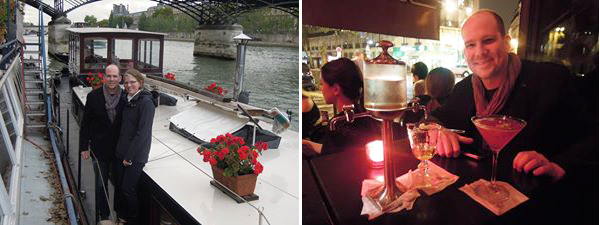
Some time during the month we had a delightful evening with my nephew Jordan and his wife Janet. Dinner in one of our favorite Paris streets (rue Guisarde in the 6th arr.), followed by a walk in the rain along Blvd. Saint-Germain and a taste of absinthe. But first we had a tour of the houseboat which was the weekend home to Jordan and Janet in Paris.

We took an afternoon trip to the beautiful Parc Monceau off Blvd. Courcelles, one of Pat’s terrific list of “stuff” she puts together for all of our trips. But even Pat could not have expected to see France’s former President Nicolas Sarkozy come running by. But there he was, with two security guards, and pleased as he could be to offer a cheery wave and allow photographs. After he passed me, Pat hollered “lookin’ good” and he said thank you.

We accidentally met Philippe at a coffee shop, and he invited us to see him perform at a comedy club not far from our apartment. Last night was the show. Even without understanding a word (it was all in French) we thoroughly enjoyed the performance, which ended with the whole audience and the cast dancing together in the street. Paris is a wonderful place.

Here I am at one of our favorite cafes, called La Favorite, a few steps from our apartment, having morning coffee and croissant, working on my novel.

It’s always great to visit with friends from Key West in Paris. Here we are having lunch and conversation with (l to r) Stan, Brian, Judy, and Susie. After lunch, in the courtyard of the Jewish museum next to the statue of Captain Alfred Dreyfus.

Now on display in a gallery in the Place des Vosges. For 37,000 euros it can be yours.

One of Paris’ most spectacular restaurants in Le Train Bleu, located in the Gare de Lyon train station … a toast to a terrific month, almost complete.

Only a few more mornings in our Paris apartment … enjoying a quiet breakfast and a special view from our window.
 The best sight in Paris. Patricia triumphant. Met her goal.
Posted in ... 2013, ... France - Paris | Leave a Comment »
* Lew’s novels
Posted by Lew Weinstein on May 1, 2014

for more about Lew’s published novels and research on the new novel, see …
Lew’s AUTHOR BLOG
for Lew’s page at amazon …
http://www.amazon.com/Lewis-M.-Weinstein/e/B002IZ1BNK/ref=sr_ntt_srch_lnk_2?qid=1398952776&sr=8-2
Posted in Uncategorized | Leave a Comment »
* it’s always fun to meet fellow travel authors
Posted by Lew Weinstein on January 26, 2014

Nancy and John Petralia, authors of “Not in a Tuscan Villa,” were in Key West this week, and Pat and I had the chance to share a drink and conversation. Their experiences reflect a willingness to seek adventure, and their telling of it is quite personal and entertaining.
Here is the review I posted on amazon and Goodreads …
This is a delightful book for many reasons.
For one, it is well written, every page taking the reader deep into the experience of two people who had the courage to take a year and do something totally different from their previous experience. There is a deep sense of adventure, a willingness and a sense of humor to accept that everything will not be as you planned, and the ability to change focus (and houses) when reality proves to be below expectations.
We go along with John and Nancy every step of the way, riding a bike, shopping, eating, volunteering at a food festival and a senior center, absorbing the culture and joy of Italy. There are great descriptions of many places you have heard of, and others not on the normal tourist radar.
***
Posted in ... Italy - Tuscany | Tagged: Nancy and John Petralia, Not in a Tuscan Villa | Leave a Comment »
* August in Nice … so wonderful we booked it again for 2014
Posted by Lew Weinstein on November 17, 2013

Our transfer from Villefranche to Nice was the easiest we have ever had. Our pre-arranged taxi arrived precisely at 10:00 am as scheduled and 20 minutes later we were dropped off at the Promenade de Englaise. Here’s a photo of the view from our apartment. I think Pat gets an A+ for this one.

***
… same view a few minutes before dawn

***
We’re settling in very comfortably in our 2nd (of 4) week in Nice. I worked all morning, wrote drafts of two scenes I am really excited about. Pat ran 4 miles. Our afternoon trip involved a local bus, several successful errands, a late lunch at an outdoor cafe, and a Velo bike ride home. OK!
.

***
Sunday morning … a visit to the outdoor market in Nice’s Old Town. Biking 14 minutes each way – no charge for the 1st half hour … Cherries and flowers, petit dejeuner … We’re working on our travel plans for 2014, including perhaps a return to Nice.
.

***
After we bought a small bouquet of flowers, the lovely flower lady gave Pat a rose, carefully removing all the thorns first.

***
We found a wonderful small street (rue de l’Abbaye) in Nice’s Old Town, lined with one picturesque outdoor restaurant after another. We chose Le Tire Bouchon; my duck and Pat’s lasagne aubergine were both superb. On the way, we met a friendly mime.

***
Pat went swimming this morning in the Mediterranean. She says the water was wonderful but the rocks were a travail. She’s out now looking to buy better beach shoes.

***
Is any comment really needed?

***
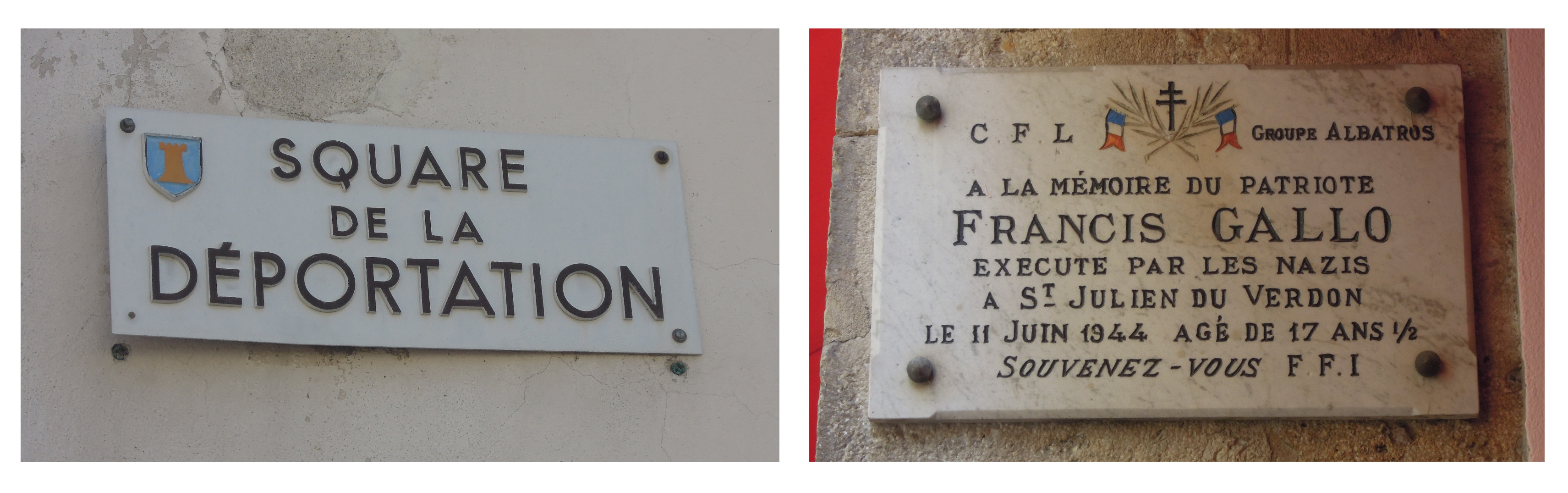
There is of course much beauty in France. There are also many sad reminders. Many.
***
We were treated to a fantastic lunch at the home of our new friends Trevor and Julia. This followed a wonderful tour (led by Trevor) of Vence and St. Paul de Vence.


***
A side trip to Cannes is a short train ride away. There are lamborghinis and yachts, but as far as I’m concerned, the best sight in Cannes was the lady who accompanied me there.

***
Another side trip by bus to Cagnes-sur-mer, to see the house where Renoir lived, painted and died. We had just seen the movie (click >>> Renoir), which is set at this home. We recommend it highly.
In addition to the Renoir home, I had the best hamburger I’ve ever had in France, with the help of a man from the next table who explained in French (to the waitress) what “medium-well” means.

***

***
Two kinds of fireworks on our balcony in Nice.

***
Pat swam this afternoon in bright sunshine … 15 minutes later, the skies darkened, rains came, and it was cool enough to get the long-sleeve shirt out of the suitcase for the first time this summer. NOTE: another 15 minutes and the sun was back.

***
Thank you for the LIBERATION OF NICE … Aug 28, 1944 … After hear Stars and Stripes playing outside, Pat looked out from our balcony and saw a long line of jeeps with American flags. We went down and watched the procession head off along the Promenade. It appeared to be French people in the jeeps, in American uniforms, waving American flags.
A sign on one jeep said “we will never forget.”
I am reminded of a young man we met in Normandy who said the same thing, adding appreciatively “you gave us our country back.” All in all, very moving.

***
The thanks to Americans for liberation of Nice continues. While sitting on the balcony, having our nightly aperitif (it may be 11am in the States, but it is 5 o’clock in France!) American WWII planes flew overhead.
Then the jeeps came again, filled with French women dressed in the 1940’s clothes and bright red lipstick, “soldiers” all wearing American uniforms, and all the jeeps sporting American flags.

***
Pat’s last swim in the Med this year …

***
Posted in ... 2013, ... France - Nice | Leave a Comment »
* a magnificent week in Villefranche
Posted by Lew Weinstein on September 14, 2013
Our objective for this week in Villefranche was to find a spectacular view and relax after the fairly hectic first month of our summer travel. This was the view Pat found and we are carrying out our plan.

***
I have been a member of Goodreads
– (sort of a Facebook for readers … http://www.goodreads.com/author/show/2950260.Lewis_M_Weinstein) –
for several years, and I truly enjoy reading and often discussing the reviews of my GR friends, which gives me a fine literary conversation each morning before I begin my own writing.
When I saw that one of my GR friends lived near Nice, I contacted him. The result was this delightful harbor side lunch with Trevor and Julia on our first full day in Villefranche and a visit with them in their home 3 weeks later (See Nice post).

***
I could have taken hundreds of photos like these (Actually I think I did). Every change of the sun or the clouds produced another spectacular vision. This one was taken soon after a short downpour.

***
I have never seen more vibrant photos than those produced by the Indian photographer Roger Bella who had an exhibit in Villefranche in a small building along the path we took from our apartment down to the sea. All of these photos are taken in the village where he lives.
See more of Bella’s stunning photographs at … http://photo.net/photos/Bienvenus_chez_moi

***
We saw fireworks over the harbor almost every night from our balcony. Apparently they are scheduled for view by those on the cruise ships which sail in and out every day.

***
We walked along the beach road to Cap-Ferrat, the site of magnificent mansions for a century, and still the playground of the very rich. On the way back, the road was blocked by the police (fallen trees?) and we had to climb to one of the higher roads. This turned out to be quite fortuitous, since we soon realized we were looking across the bay from exactly the viewpoint of Cary Grant and Deborah Carr in “An Affair to Remember.” We looked to our right and there was a road which we choose to believe led up to Janou’s villa.


Later that night, we watched the movie on our balcony, looking across at the same view shown in the movie.

***
One of Villefranche’s major attractions is the Chapelle Saint-Pierre, dating from the sixteenth century. Used as a storeroom for local fishermen’s nets and equipment for most of the 19th and early part of the 20th century, it was restored in 1957 with Jean Cocteau adding murals depicting the life of the saint and of local fishermen.

***
Of many beautiful views of Villefranche, here are just a few …

And last, since this is our scrapbook, the living space in our beautiful apartment …

***
Posted in ... 2013, ... France - Villefranche | Tagged: An Affair to Remember, Capelle Saint-Pierre, Jean Cocteau, Roger Bella, Villefranche | Leave a Comment »
* finding my novel “Hereje” (“The Heretic” in Spanish) in a book store in Madrid was a thrilling experience
Posted by Lew Weinstein on August 30, 2013
post updated 9/6/13 …
My first novel, The Heretic, was published in Spanish last year. Shortly after arriving in Madrid, we passed a bookstore. I cannot tell you what a thrill it was to find a copy, which I promptly autographed.

purchase * THE HERETIC at amazon.
***
Madrid is a beautiful city. Our hotel, the Catalonia Las Cortes, was elegant and comfortable, and perfectly located. As we do in all cities, we walked and soaked up the sights. The ambiance of outdoor eating, and the good but inexpensive food, was a great combination.

We went to see Guernica, and to the Prada. No photos allowed at either, so here is a photo I took on our last trip to Madrid, when I am sure it was permitted. It is absolutely stunning to stand near this painting.

The first portion of our trip, and our new travel program – New York, Maine, Martha’s Vineyard, Falmouth, Boston and Madrid – was complete. Now to France for August and September.
***
Posted in ... 2013, ... Spain - Madrid | Tagged: Guernica, Hereje, Lew Weinstein-author, Madrid | 2 Comments »
* a quick visit to Boston
Posted by Lew Weinstein on August 30, 2013
From Falmouth, we took a bus to Boston, our last U.S. layover before heading to Europe. Boston is a great city, and two nights were hardly enough, but we made the most of it. We had a chance to spend time with Ed Demore, another Key West friend, and with Pat’s niece, the beautiful Bridget. Two nights, two great dinners in the North End.

We ate with Ed in an Italian restaurant. Our mouths dropped when we saw the painting on the wall, the Ponte Vecchio in Florence and, off to the right, the apartment we stayed in when last in Florence in 2011.. The photo below is the same view.

The big news in Boston was the trial of Whitey Bulger for 29 murders and other assorted crimes. As a former criminal defense attorney, Pat couldn’t stay away from the courthouse. We couldn’t get in to the actual trial (only a few seats for the public, get in line at 3:00 am), but were a few courtrooms away watching a live video feed of the testimony of Stephen “The Rifleman” Flemmi. Even for me, it was fascinating. Whitey has since been found guilty on many of the charges and is awaiting sentencing.

On our second morning in Boston, we packed, left the bags in our hotel, and took a great walk through Faneuil Hall, the Boston Common and out onto Beacon Street. Billy Rodgers shoes are still there, but alas his store is gone. Along the way, I was interviewed about Anthony Weiner and his bizarre campaign for Mayor of New York. The finish line of the Boston Marathon, a scene of devastation not too long ago, brought reflection, sadness, and anger. We had lunch, and as you can plainly see, began our diets.

We grabbed a cab back to the hotel, picked up our bags, and continued to Logan. Hence to Madrid.
Posted in ... 2013, ... US - Boston | Leave a Comment »
* across the sound to Falmouth on Cape Cod
Posted by Lew Weinstein on August 30, 2013
We left Martha’s Vineyard from the Edgartown pier on a ferry that carried us across the sound to Cape Cod, where we were met by our Key West friend George Fontana holding a cardboard sign proclaiming “LIMO.” After we finished laughing, George took us to the summer house he shares with John Andola. Also visiting were Jim and Cathy Stentzel, also from Key West. Almost immediately we were on the water again, this time on “Grumpy Old Men,” where John served lunch and we took a swim.

The guy in the picture above is crabbing or something – while smoking his cigar. Went down, came up, never missed a puff.
John and George were terrific hosts. The conversation was delightful. It was great to be with Jim and Cathy. Six of us from Key West enjoying Cape Cod! And the food on their back deck overlooking the water was just great.

Falmouth is a place of great beauty. Here are two photos that capture just a smidgen of what there is to see.

***
Posted in ... 2013, ... Falmouth, Cape Cod | Tagged: ... Falmouth, Cape Cod, Falmouth MA | Leave a Comment »
* Martha’s Vineyard … 1st time since 2005
Posted by Lew Weinstein on August 2, 2013

this photo wasn’t taken until nearly the end of the week, but it just has to come first
For many years, we vacationed with our children for one week each summer on Martha’s Vineyard. But then they all got older, got married, had children, and there was no house big enough, nor did they all have the time or the inclination, amidst conflicting demands, to come. Also, of course, we had purchased our apartment in Collioure, France, and that pretty much took us out of the U.S. picture in summer-time. So our last time on the Vineyard was 2005. Although only three of our six children could come this year, we were still hoping for a glorious week. We would miss the others, but we understood why they weren’t here.

our Cape Air plane
From Portland, we drove to Boston’s Logan airport and caught a tiny Cape Air flight to the Vineyard – the kind of flight where they ask how much you and your carry-on luggage weigh before you get on the plane. The pilot looked as if he might be celebrating his Bar Mitzvah that night. But he flew a perfect flight. We just missed seeing Fareed Zakaria who we were told landed on the plane just before us.
Two of Pat’s group had arrived earlier and they met us at the airport. By that time, the cleaners were finished and we could occupy our rental house. Later that afternoon, my son and his family arrived. They had rented another house, less than a half mile away. On the first night, Kevin & Dawn and Kerry & Susan were all exhausted from their long overnight drive to Wood’s Hole. So Pat and I took some of the food we had just purchased and went to the other house to see Jon, Stacie, Evan & Natalia. Jon cooked the hamburgers and we enjoyed our first visit with them in several months.

Pat at Edgartown harbor
The next morning (Sunday) Pat and I rode into Edgartown on Kerry and Susan’s bikes (about 20 minutes). It looked very much the same as we remembered. We had lunch at Flowers, bought a NYT at the Paper Store, and biked back. That night, dinner was at our house, with Kerry & Susan cooking. This continued the long-standing tradition of one couple taking each dinner – preparation and cleanup – that had evolved over the many years of MV visits. Jon and Stacie brought the kids, and we happily gave up the idea of a quiet repose. Pasta and shrimp. Lots of conversation. Lots of laughs. Later in the week, Dawn & Kevin cooked twice and Jon & I shared a night.

This was a wonderful house. Plenty of space, indoors and out, everything you would need. And a bonus. After we rented, the owner put in a/c. How delightful in a week that was often 90 degrees.
The week went much quicker than we knew. Everybody was busy. 30 mile bike rides. 3 mile runs. Trips to the beach. Pat and I took the grandkids one night and the next morning to give their parents a “sleep-in.” We went for a great walk, met a lady who had lived on island for almost 90 years, saw chickens and horses. We also played catch, soccer and kickball (where are the photos for that?). Jon and I had time for a quiet lunch. Pat, Kerry and Kevin for a rigorous run. There was so much physical activity that Dawn said she felt like she was at a “fat camp.”

***

One night we watched Jaws, in preparation for a Jaws walking tour in Edgartown the next day. (Check out Mike at Amity Tours. He did a great job, showing scenes from the movie on his iPad as we stood at the locations.) We learned many fascinating details. MV got the film, instead of Nantucket, due to a foggy morning when the site-selection person’s ferry to Nantucket was cancelled. Speilberg was such a perfectionist he took 4 days to shoot the opening scene planned for 4 hours. The mechanical shark got fouled up in the salt water. The film crew was supposed to be gone by July 4, but didn’t finish until September. One scene was shot outside the Old Victorian Inn where Pat and I spent our honeymoon in 1984.

Pat took the opportunity to teach the grandkids important new skills …

***
Did you notice all the shirts with the black dogs on them? This is a continuation of a family tradition started many years ago. The shirts are from the Black Dog, first a restaurant in Vineyard Haven and now a nationwide mail-order retail merchant. The shirts have the years on the back, and we have, among us, quite a collection.

***
Here are photos from 2005. We’re all 8 years younger, and some of us are just a tad thinner. Also, Josh, Steph and Blake are with us. This year, Blake was too busy helping his team win one baseball tournament after another …

the Weinstein group in 2005
***

the Lenny group (and me) in 2013
***

some things never change
***
Finally, our week was over, and as dusk settled in, it was time to pack up and move on. Next stop, Falmouth with our Key West friends.

***
Posted in ... 2013, ... US - Martha's Vineyard | Tagged: Edgartown, Jaws, Martha's Vineyard | Leave a Comment »
* Maine … one week each in Camden & Portland
Posted by Lew Weinstein on July 31, 2013
We finally got our car from Hertz in Boston and set off north to Maine. Our purpose for our two weeks in Maine was to find a place where we might, in a later year, stay for a month or more. Spoiler alert … although we found things to enjoy in both cities, we agreed that one week was enough for either.
Our travel day had begun with a 6:00 am taxi to Penn Station in New York, then a 4 hour train ride to Boston, and finally a confrontation with Hertz regarding their non-existent South Station office. Already tired and aggravated, we set off on the 200 mile drive from Boston to Camden, Maine.

Leaving Massachusetts and passing through a little corner of New Hampshire, we came into Maine and passed Portland. It was time to take a break. The signs said Freeport was up ahead. We had been there years before. LL Bean-land. Only a few miles off the interstate. And what a break it was.
We have no photos. Blame Ben or Jerry.
We each got double decker cones with caramel and were innocently slurping away when we looked at each other – covered with drippings, too sloppy to hold a camera. Laughing at each other like two 3 year olds. Perhaps this happens often, since there was a washroom readily available. We cleaned up and continued to Camden.
Camden, ME
.

Tall ships in Camden harbor
Camden ME is a delightful town located on a picturesque harbor in Penobscot Bay. We had been here before, many years ago on one of our first trips together and more recently for two different windjammer voyages on the tall ships which are based here.
Our rental apartment was a 5 minute walk from the harbor, restaurants and shops. And it is a beautiful place, spotless and convenient. Whenever we needed something, it seemed to be just at hand. If you visit Camden, you couldn’t do better than …
Marigold Cottage at http://www.homeaway.com/vacation-rental/p188200.

Our main need, wherever we go, is a comfortable, beautiful place to read (and for me, to write). So need #1 was quite well satisfied, especially when we found the NYT at the local supermarket.
The WIFI, another crucial requirement for us, worked perfectly. The only negative was the TV. It worked fine, but the only baseball games it received were the Red Sox.
A sunset sail is a high priority in Camden. And the ship to take was the Appledore, which had just relocated from Key West, where it spends the winter. We met the crew, signed up, and enjoyed a sail in quite cool weather.

The other principal attraction of Maine is the lobster. Both in Camden and the next week in Portland, we took every opportunity to indulge.

.
Portland, ME
.
The ride from Camden to Portland was uneventful, except for the fact that the a/c conked out on a 90 degree day. Our first stop in Portland was the Maine Mall. Pat needed to sign in for the next day’s Color Run, and we made our obligatory visit to the local Apple store, this time to learn how to do some things on Pat’s new iPod touch. With both tasks accomplished, we found a restaurant and, during lunch, called Hertz to arrange for a car swap at the Portland airport. This went smoothly, and we headed to our apartment on Portland’s Eastern Promenade, about a mile from downtown.
The apartment, part of a really upscale condo group which we think serves mainly corporate clients, was spectacular, including the view of the water from our small terrace. Portland Maine Rentals … http://portlandmainerentals.com/218eastern1.html

wine & cheese on the terrace
.
Color Run
.
The next day was the Color Run. Thousands of runners do an untimed 5k run while being pelted with colors from cannons and bags and who knows what else. Can’t explain. Just look at the photos …

.
Edward the watchmaker
.
One morning Pat’s watch stopped. It was a new battery in her favorite Mickey Mouse Seiko watch, a gift from her son Christopher in honor of her graduation from law school. So it’s important. She called several jewelers from the Portland Yellow Pages. One said he didn’t work on Seikos. Another said he didn’t have any batteries. Then there was Edward.
“Come right over! Do you know where I am?”
“I have your address.”
“But you won’t find me. It’s hidden. Do you know where they have the fireworks?”
“Yes.”
“It’s not there. Go to Washington Street. Look for a yellow sign on a red building. Or maybe it’s a red sign on a yellow building. But you’ll see it. If you get lost, call me.
So … we found Edward, actually quite easily. There was another customer being serviced. We looked around the shop. It seemed as if every job Edward had worked on for the past several decades was still displayed on some counter or shelf.
“Are you the one who called me?”
“Yes.”
To the other customer, “You wait. I need to serve this lady first.”
He looked at the watch. “It’s not the battery. Whoever put the battery in knocked off the connection. They tried glue but it didn’t work. You’re lucky you came to a real watchmaker this time. There aren’t many watchmakers left. But I can’t fix it right away. Can you come back tomorrow?”
As we were leaving, I saw a display of watchbands. I needed a watchband. “Can I see those?”
“No, you can’t have those. They’re antiques.”
The following day, we returned. The watch was ready. Edward proceeded in great detail to explain what the problem had been and what he had done to solve it. He drew a diagram and gave us detailed instructions to use the next time the battery needed to be changed.
“Are you going to come back to change the battery here?”
“No, we don’t live here.”
“You can’t fly back?”
Maybe we should. It’s worth a trip to Portland just to have Edward fix your watch.

Edward the watchmaker
.
the MOMA in Portland
.
A selection of the William S. Paley collection from the MOMA was at the Portland Museum of Art while we were in Portland. Lucky us.

***
Posted in ... 2013, ... US - Maine | Tagged: Camden ME, Maine, Portland ME, Portland Museum of Art, William S. Paley collection | Leave a Comment »
* getting from New York to Maine … problems with Delta and Hertz
Posted by Lew Weinstein on July 29, 2013
From New York we went to Maine, but getting there did not go as we had planned.

We had booked an early Saturday morning flight from LaGuardia to Portland, ME. On Friday, I got an email from Delta, saying they had cancelled our flight and were re-booking us from LaGuardia to Detroit to Portland … on Sunday!
I called Delta and also Expedia, through whom we had made the reservation. Why was the flight cancelled, I asked, when 3 other flights from LaGuardia to Portland later on Saturday were still scheduled to go? Weather we were told. The whole east coast was a mess. New York airports were closed down.
This seemed strange to us, since we were actually in Manhattan and the weather was fine. I think Delta was not truthful, probably because weather-related delays do not obligate them to make refunds.
Of course Delta would not pay for the extra hotel night in New York. Amtrak was the alternative. We booked a Saturday morning train from New York to Boston, and changed the Hertz pickup from Portland to Boston. I cancelled the Delta flight and demanded a refund, which was at first refused. After some “additional discussion” Delta changed their mind and within two days had processed a full refund. I can’t be sure, but I think the fact we had booked through Expedia created some additional leverage.
The train ride to Boston was pleasant and uneventful.

We arrived at South Station Boston, where we had booked with Hertz to pick up our car. But there is no Hertz office at South Station. No car. No sign. No instructions. I spent 30 frustrating minutes on the phone – mostly on hold – before finally hearing an automated message that we had to take a taxi to another Hertz location in Boston, reimbursable up to $10.00.
The counter person at Hertz Park Place location was sympathetic and cheerful. She said they had not had a South Station office for a long time, and the branch manager was supposed to have changed the web site and put some kind of signage/instructions at South Station.
The branch manager was first “too busy to see us” and then unapologetic and brusque and full of “attitude” when she finally deigned to appear. She told me that my reservation said we would have to taxi to an other location, an assertion that turned out not to be true. Then she turned her back and walked into her office.
My subsequent conversations with Hertz customer service were intended to get that arrogant lady with attitude fired, or at least disciplined. I have no idea if I succeeded. I did receive several emails from a Hertz customer service representative, who had gone to the web site and confirmed that reservations could still be made for pickup at South Station. (NOTE: it has since been changed.)
Later, the rental car lost a/c and we had to make an exchange in the Portland airport. The attendant there was most helpful and went out of his way to get us a suitable replacement in record time.
Hertz is not a bad company, but they should really deal with that “bad apple” in Boston.
Posted in ... 2013, planes, trains & automobiles | Leave a Comment »
* a different kind of summer – first stop New York City
Posted by Lew Weinstein on July 28, 2013
Since we sold our apartment in Collioure, this summer represents the first version of Plan C. Our intent is to go to fewer places and stay longer than we did when we were doing home exchanges from our Collioure base. However, the first month or so of Plan C (from late June to early August) turned out to be a series of short visits – to NYC, Camden & Portland ME, Martha’s Vineyard, Falmouth MA, Boston, Madrid and Villefranche.
New York City was our first stop. We flew from Key West to Miami to LaGuardia, and then to our favorite NYC hotel, the Milburn on W. 76th St near Broadway. There were three main activities: a Merms Pizza night, 3 New York Yankees games, and a visit from Pat’s kids Chris & Becky and Kevin, with her grandson Sean.
“Merms” is an abbreviation for Mercury Masters, the running club of women over 50 who run marathons that was a major part of Pat’s life during our 14 years in New York. Whenever Pat appears, a group of wonderful ladies in great shape gathers at Dean’s on the West Side for pizza and conversation. And they let me attend.

Not by coincidence, the Yankees played three times during our stay in NY. I went first with our friend Dan, the owner of Rosa Mexicana, then with a college friend from Princeton I’ve seen only once in the past 50+ years, then with my son Josh and grandson Blake.

We met Pat’s sons Chris & Kevin, with Becky & Sean, at Penn Station, and the day included Times Square, Grand Central Station, the Empire State Building, and lunch at NY’s new hot burger joint called Shakeshack.

New York is a photographer’s paradise. There’s something interesting and beautiful wherever you look. Here are three scenes that caught my eye … Central Park seen from Central Park South, a cityscape from inside the lobby of the Time Warner building, and a typical New York collection of water towers viewed from our hotel room.

***
Next … Maine and some aggravation getting there.
Posted in ... 2013, ... US - NYC | Leave a Comment »
* Getting ready to leave Key West … some memories
Posted by Lew Weinstein on June 21, 2013
We’ve been in Key West since October (almost 9 months) which is the longest consecutive time we’ve ever spent here. It has been wonderful, but we’re ready for some travel, and we have an exciting summer planned.
Before leaving, however, I put together a selection of photos to remember what we’ve been up to. The photos are in no particular order, nor are they a complete record.
***

 ***
***

***

***
Posted in ... 2013, ... US - Key West | 2 Comments »
* you never know who might show up …
Posted by Lew Weinstein on April 15, 2013

If you have a St. Paddy’s Day party in Key West,
you never know who might show up.
Posted in ... US - Key West | Leave a Comment »
* Positano and the Isle of Capri … with Paris before and after
Posted by Lew Weinstein on March 30, 2013
What a great way to finish the summer. We left Dublin on Sep 17, flew to Paris, and spent 2 nights at the Hotel des Deux Iles on Isle St. Louis. Our friends Rivian and Hans were in Paris and we had dinner with them at one of our favorite little restaurants, Sorza, just down the street from our hotel.

We flew from Orly to Naples, where a van picked us up for the 1 hour trip to Positano. Along the way, we had spectacular views of Vesuvius. But even more spectacular was our room at the Eden Roc Positano, which unfortunately none of my photos does justice. Here, however, are the views from our room and at Pat’s birthday dinner at the hotel’s roof-top dining room.


leaving Positano
We took a short ferry ride from Positano to the Isle of Capri, where we were met at the dock by a representative from the Hotel Luna. To get to the hotel, we took a funicular up the side of the mountain, then at the top walked to the other side. The hotel and the views were spectacular.

the view from our hotel room

After two short days in Capri, we took the big ferry to Naples, and then a taxi to the airport. Back to Paris, for the last act in “The Paris Bag Job.” We had left 3 suitcases in our friend’s apartment in Paris, taking 2 with us to Dublin and the Amalfi Coast. Once back in Paris, we took a cab to retrieve the suitcases, making sure the driver waited to take us back to the hotel. We had one more day in Paris, enough time to get haircuts and then duck into a nearby bistro to avoid a sudden rain shower. A great finish to the summer of 2012 and 7 summers based in Collioure.

Posted in ... France - Paris, ... Italy ... Amalfi Coast | Leave a Comment »
 TRAVEL with pat and lew